
EmoVerity
Core Curricula (Levels 1 & 2) – Developing skills
Progressed Program (Levels 3 & 4) – Developing fluency

EmoVerity Training Overview
Please note that EmoVerity training is only available to adults 18+
Understanding the world of emotions can be perplexing.
Some people seem to possess an innate sense of what they are feeling, can express themselves with ease, and often benefit from the ability to recognize emotions in others with great accuracy. Others struggle with these emotional intelligence skills, but learning them doesn’t have to be a mystery.
EmoVerity provides a repeatable, reliable, and sustainable technique to induce, identify, and release emotional states at will.
Most participants come to EmoVerity training looking for a reliable alternative to Emotional Recall/Affective Memory (using their personal memories to empower roles for stage and screen). What surprises most students is how much this course can improve their personal lives.
This training helps you to:
Name what you are feeling. Current research trends show that affect labeling reduces intense emotions*. Being able to name what you are feeling, particularly strong emotions, helps to release the pressure.
Identify emotion communication. Miscommunication is a large source of stress. Learning to identify common emotional communication patterns helps us, in turn, to become clearer communicators and develop curiosity for the communication styles of others.
Stay present in the moment. All emotions have a purpose. No emotion is bad, all are useful. Allowing ourselves to be present for and stay with an emotional moment allows us to move through personal resistance and avoid suppression.
Befriend your emotions. Having a reliable set of tools to induce and release emotional states creates personal autonomy, agency, and self-sovereignty. When you feel safe and confident in your own body you can choose when to be brave, when to be vulnerable, when to be more curious, and when to step away.
*Chen, J., van de Vijver, I., Kenemans, J. L., & Baas, J. M. P. (2026). Impact of affect labelling as an implicit emotion regulation strategy on negative and positive emotions. Cognition and Emotion, 1–18.
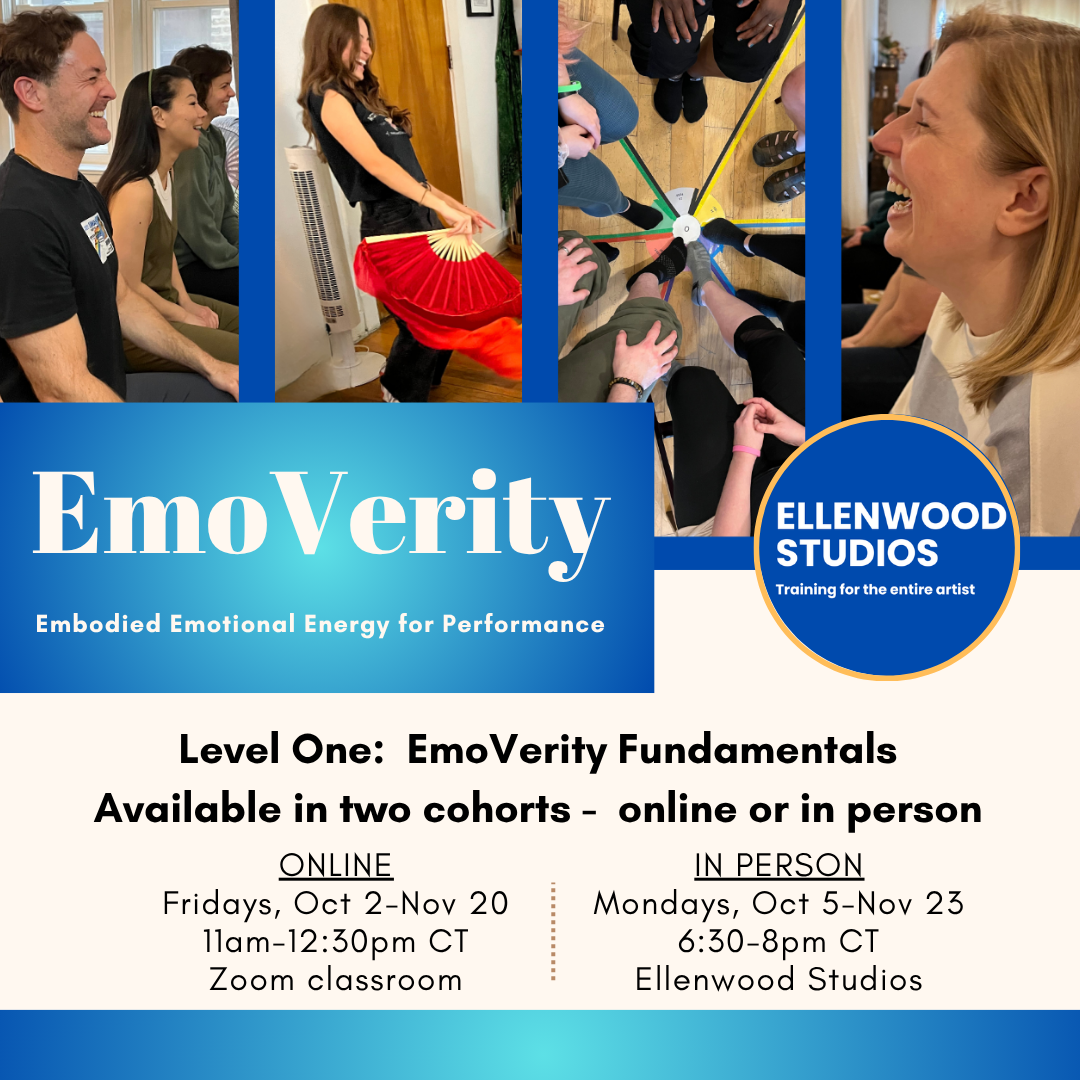
EmoVerity Level One: Fundamentals
Performers, you are not required to fill your head with dark and traumatizing thoughts or use personal memories to create powerful performance on stage and screen. Teachers, coaches, and directors may have led you down that pathway in the past with best intentions in the interest of creating powerful emotionally connected performances. EmoVerity provides a non-invasive path leading you to the same destination.
"Studies show that professional actors and performers are more likely than their civilian counterparts to suffer from depression, anxiety, and various other mental health struggles." Arias, Gabrielle L. (2019) In the Wings: Actors & Mental Health A Critical Review of the Literature. Master's Thesis. Lesley University. Cambridge, Massachusetts.
Many people believe the Myth of Innate Competency – 'We all experience emotions, so we are already emotional experts with an infinite catalogue of expressions, intensities, and mixes. Emotional expression in performance comes from living life and drawing from your own personal experience.’
The assumption that all performers possess a complete understanding of all emotional possibilities for performance is highly inaccurate and is especially harmful to people with neurodiversities such as alexithymia, social-emotional agnosia, Social Anxiety Disorder and Autism.
We can all benefit from Social Emotional Learning processes and cultivating embodied emotional intelligence. EmoVerity was created to help participants to befriend their body, mind, and communication choices through somatic recognition, boundaries work, consent, and empathy for self and others.
Do you dread crying (raging, laughing, etc.) “on demand” for your self-tapes, live auditions and characterization process?
Are you finding rehearsal processes and performances draining due to giving too much and not having enough for yourself?
Have you ever felt “shadowed” by the emotional life of your character in your off-stage/off-screen life?
You will learn how to shift your characterization and performance process from ‘scared and stuck’ to ‘alive and thriving’ and leave the character’s life on set so you can more fully enjoy your personal life.
Together we’ll explore somatic shifts that begin with specific breath patterns.
These patterns lead us to experience physical emotional shifts (in facial expression, body posture, and voice) that are recognizable to oneself and others, and do not rely on accessing and appropriating your personal memories to catalyze a character’s emotional life.
By the end of our training, you will have learned a process to identify, induce, regulate, and release six emotional states at will through the body.
Begin a new journey of emotional ease with EmoVerity Level One.
Tuition
At Ellenwood Studios, we offer tiered pricing. All participants, regardless of price, will receive the same workshop and companion online classroom containing learning goals and homework practice videos, downloadable and fillable PDF worksheets, and supplementary materials.
This equity pricing structure was created to amplify training access for those who hold marginalized identities and those experiencing significant financial hardship.
If neither of those qualifications apply to you, please consider enrolling at the Supporter or Sustainer Rate, which supports the ability to offer Scholarships and a Community Rate to folks experiencing financial difficulties.
Supporter Rate (covers your enrollment + supports peers) - $550 (regular price - $700)
Sustainer Rate (covers your enrollment) - $450 (regular price - $600)
Community Rate (supported by your peers) $350 (regular price - $500)
Registration options
Registration for January 2027 opens soon. Please sign up for our newsletter for an announcement.
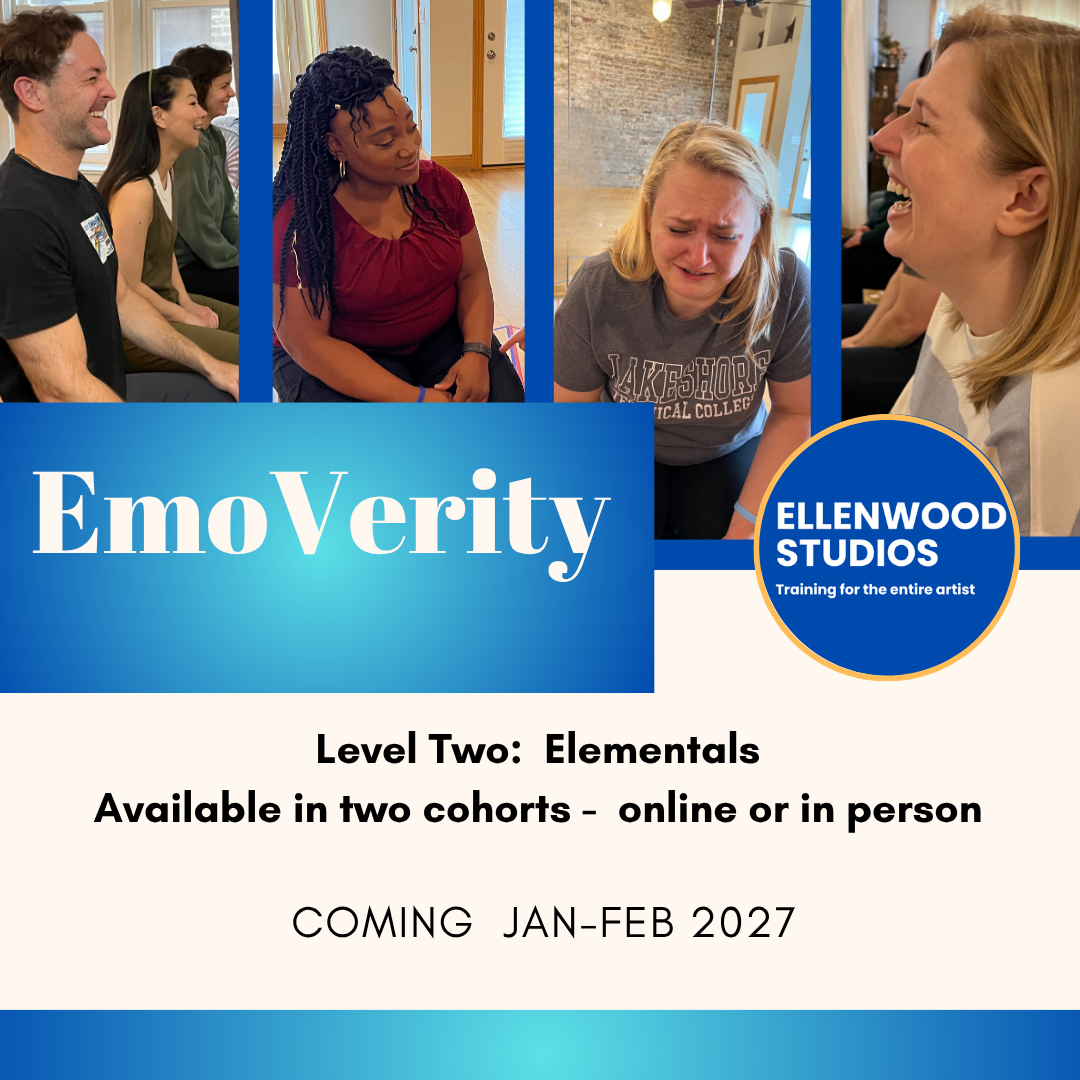

EmoVerity Level Two: Elementals
Prerequisites: EmoVerity Level One or prior Emotional Effector Pattern training
The dreaded plateau. It is a part of acquiring any new skill and can be deeply frustrating.
After level one, you may have experienced more insight about the power of emotions in your life. As you practice the six Emotional Effector Pattern there is a pathway for successful connection to and release from emotional states, but frequently there is also a feeling of being stuck where you are with a box of six emotional colors and feeling more stereotypical than profound in your emotional connection to these colors.
The Emotional Effector Patterns (along with Zero/Step-out) are excellent at providing a strong foundation for the induction and release of emotion, and imbue our art with emotional vibrancy; but 6 primary colors of emotion cannot be expected to express the nuance found in the rich diversity of our shared human experience.
Do you find yourself continually drawn to certain emotional habits such as relying heavily on sadness or anger to create a powerful emotional shift?
Are your facial expressions more like masks than living expressions?
Have you been able to fully access some Emotional Effector Patterns only to have one or two remain elusive?
EmoVerity Level Two guides the performer through a process to tailor each Emotional Effector Pattern to suit you as an individual, helping to accelerate emotional induction and provide emotion expression options that are more fulfilling to experience and observe.
In life, variation is the norm and performers need to be able to fully embody their character's journey with emotional complexity. To accomplish this task this course explores:
The (approximately) 42 muscles of the face and their contribution to variations of the Emotional Effector Pattern facial expression recipes. This effectively expands your emotional colors from 6 to 64+ bringing your nonverbal communication skills to the next level.
The power of eye gaze cues and how they affect both internal life, and external communication received by others.
The possibilities of subtle breath changes to refine, shape, catalyze, and shift emotion induction through the breath component of the Emotional Effector Patterns
The fullness of the body and head postures in motion, standing, and sitting.
Break through the limits of the plateau and take your training to the next level with EmoVerity Level Two.
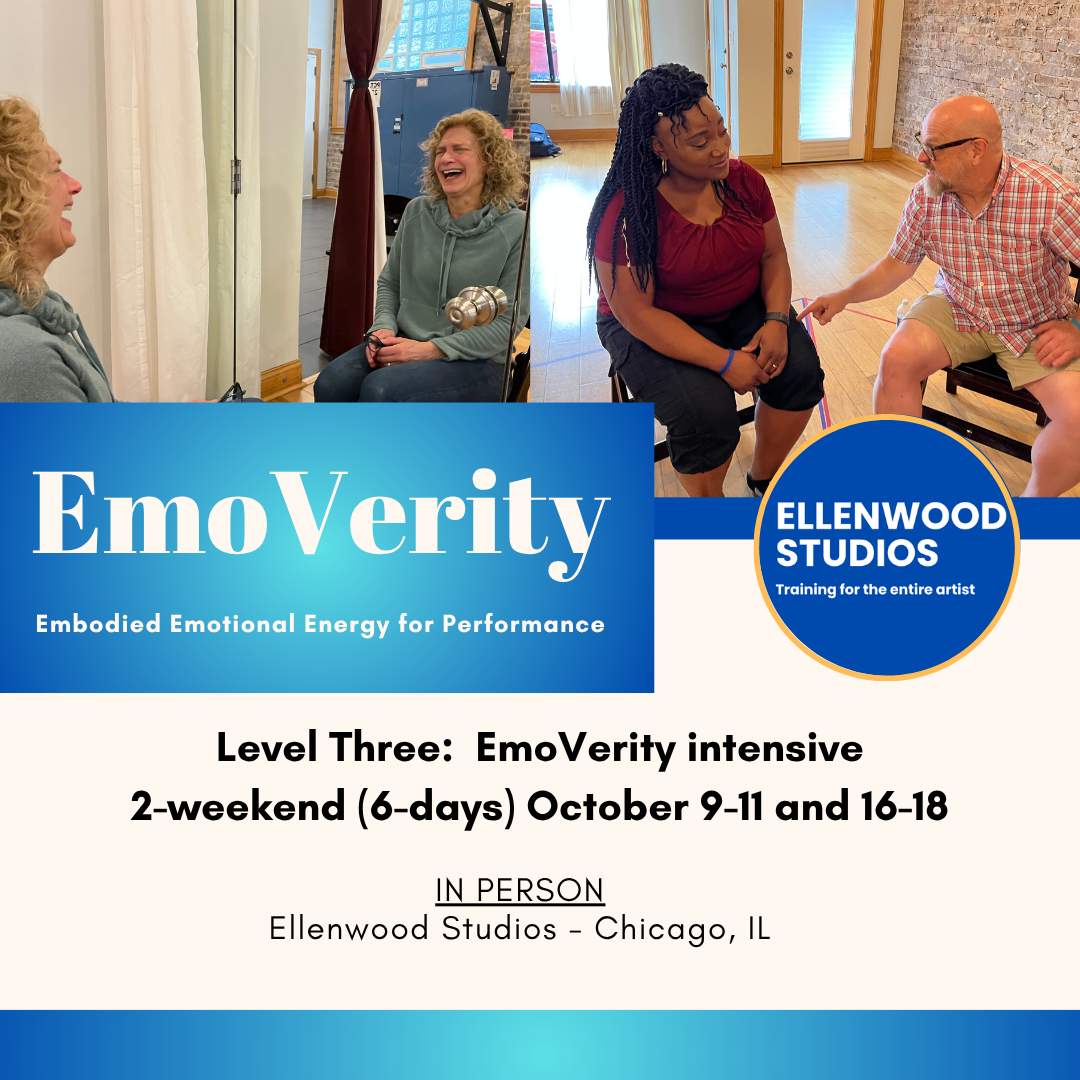
Level Three - Intensity Investigations
Prerequisites: EmoVerity Level Two
Scenario: You get a callback for a character that has a wide emotional range, it is due tomorrow, and your coach isn’t available to help you prepare.
EmoVerity Levels One and Two have prepared you to explore the emotional life of the character and lessen your own anxiety around auditioning, but you aren’t sure how to make this taped submission come alive for casting and book the role.
You have heard that “acting is in the eyes”, so what do you do with your hands?
Have you ever received the note that your performance is “too large” on camera, or “too small” on stage?
Are there times when you feel lost without a director or a coach to help you with your character choices and blocking
Do you ever look at someone and have absolutely no idea what they are trying to communicate?
EmoVerity Level Three explores emotional intensity and nonverbal communication tools for scaling your performance from the smallest emotional expression possible (perfect for on-camera close-up shots) to high intensity emotional expressions (excellent for large venue performance). Participants will also learn a process to systematically analyze real world emotional expressions to better assess what is being communicated.
Just as dancers learn their positions and musicians learn their scales, we will learn to harness the technique process of maximizing and minimizing Emotional Effector Patterns to develop fluency between the media of stage and screen.
When the Emotional Effector Patterns shine through clear nonverbal communication choices, exciting possibilities for characterization and blocking emerge and we can coach ourselves.
Each culture possesses gestures, space/boundary markers, eye contact, touch, and voice cues. We will explore scientific categorizations and measurements for each of these cues to bring our nonverbal communication to the next level.
You have learned the vocabulary of emotions, EmoVerity Level Three begins the process of practicing conversations to see how clear your communication can be.
Level Four: Systems
Prerequisites: EmoVerity Level Three
You are an emotional athlete and can induce and intensify, reduce and release emotional states at will!
You can observe and identify complex emotional states in yourself and others, but the thought of layering, blending, and mixing emotions for performance still feels like a mountain to climb.
There are already so many possibilities to choose from, and the work becomes even more complex when considering elements such as genre or style, and discipline differences between on-camera and on-stage performance practices.
Are your choices stuck in various intensities of the same emotion?
Can you accurately recognize which elements you (and others) are expressing when feeling (and embodying) two or more emotions at the same time?
Can you create a compelling mix for emotional communication choices when cast in various styles and genres of performance?
EmoVerity Level Four provides participants with our exclusive, science-informed EmoVerity methodologies for expressing recognizable, nuanced, and captivating emotional blends useful across all performance disciplines.
In everyday life we live in blended or mixed emotions, feeling multiple emotions at once. Like a painter, we will learn useful processes to mix 2-3 emotions to create new colors, shades, and palettes for performance.
We will use the behavioral analysis/deconstruction processes (learned in EmoVerity Level Three) and apply them to theatrical and on-camera performances to understand how and why these performances are so engaging.
The embodied performance of various genres, styles, and performance venues requires the ability to convey emotions in a way that is real and remains true to the world in which the story takes place. We will begin to identify these elements and transfer them to monologues and songs.
Level Four completes the progression of EmoVerity training and prepares participants for our Advanced Artistry courses which transfer and integrate EmoVerity tools and skills into the needs of specific performance disciplines: on-camera, singing, theatre, voice over.